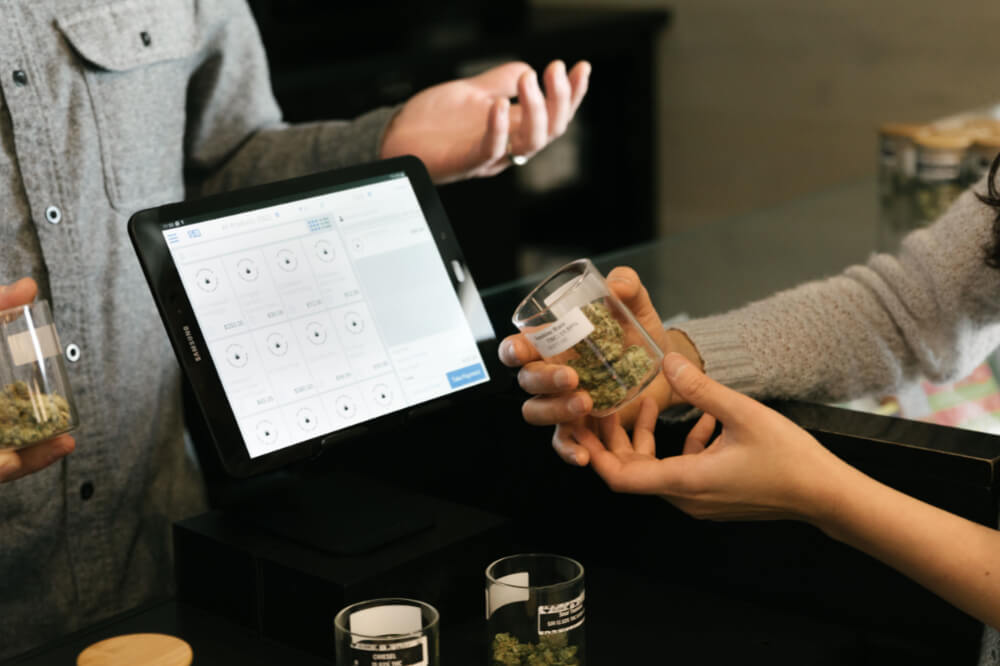
The point-of-sale system is the operational heart of every dispensary. It enforces purchase limits, verifies age, applies taxes correctly, syncs inventory with state tracking, processes compliant payments, and generates the daily reports that keep the business legal. A bad POS choice costs more than money — it costs license risk, customer experience, and staff morale every single day. Yet many operators choose POS based on a sales demo rather than operator-tested reality.
This guide compares the four major cannabis POS systems in 2026, what hardware actually works, what compliance features are non-negotiable, and how to avoid the contract traps that lock operators into systems they hate.
What Cannabis POS Must Do That General POS Cannot
A cannabis dispensary POS must enforce state-specific purchase limits in real time. California limits adult-use customers to 28.5 grams of flower, 8 grams of concentrate, or 6 immature plants per day. Medical patients have different limits. Out-of-state customers in some states cannot purchase at all. The POS must verify ID via barcode scan, calculate equivalent weights across product types, and block transactions that would exceed limits.
Tax calculation in cannabis is brutally complex. California stacks state excise tax, state sales tax, local cannabis tax, and local sales tax, and the rates change by jurisdiction. A POS that miscalculates by even 1% creates compliance problems and customer disputes.
State tracking integration is mandatory. Every transaction must immediately deplete the corresponding package in Metrc, BioTrack, or whatever state system applies. Sync failures between POS and state tracking are the most common audit finding.
Dutchie POS — Online Ordering Giant Now in Hardware
Dutchie acquired Greenbits and LeafLogix to consolidate the cannabis tech stack, then launched Dutchie POS to compete directly with Flowhub and Treez. Dutchie’s strength is online ordering — it powers menus and online ordering for the majority of US dispensaries. The POS extends that integration to in-store.
Pricing starts at $599 per location monthly plus payment processing fees. Hardware bundles cost $3,000 to $6,000 per register. Dutchie includes integrated payment processing through Dutchie Pay, which uses ACH for compliant cashless payments at typically lower rates than third-party processors.
Strengths — best-in-class online ordering integration, strong customer-facing menu and ecommerce tools, integrated payments, and modern interface that staff learn quickly. Weaknesses — Dutchie has acquired so many companies that the product is still being unified, and operators report bugs and feature gaps that legacy Greenbits and LeafLogix users find frustrating.
Flowhub — Retail-Focused Veteran
Flowhub built its product specifically for cannabis retail from the start, without trying to serve cultivation or manufacturing. The focus shows in workflows — checkouts move fast, budtender tools are well designed, and reporting is operator-friendly.
Pricing starts at $499 per location monthly. Hardware bundles around $2,500 to $5,000. Flowhub integrates with most major payment processors, online ordering platforms, and loyalty programs.
Strengths — purpose-built for cannabis retail, strong reporting on budtender performance and basket analytics, mature integrations across the cannabis tech stack. Weaknesses — limited to retail, so multi-vertical operators need additional systems, and pricing scales aggressively for add-on modules.
Treez — Enterprise-Grade for Multi-Location
Treez serves larger MSOs and multi-location independents that need enterprise reporting, centralized purchasing, and multi-location inventory transfers. The platform handles the complexity that single-store-focused POS systems struggle with.
Pricing starts around $700 per location monthly and scales based on transaction volume and modules. Hardware costs are similar to competitors.
Strengths — best enterprise tooling, strong analytics across locations, mature API for custom integrations. Weaknesses — higher complexity means longer onboarding, typically 60 to 90 days versus 30 to 45 for simpler platforms. Smaller operators may find the feature depth overwhelming.
Cova — Simpler and Faster to Deploy
Cova serves single-store and small chain operators with simpler workflows and faster setup. New stores can be live on Cova within 14 days versus 30 to 60 days for more complex platforms.
Pricing starts around $349 per location monthly. Hardware bundles are competitive at $2,000 to $4,000.
Strengths — fast onboarding, intuitive interface, strong support for new operators. Weaknesses — less customization than enterprise platforms, fewer integration partners, and reporting depth that ambitious operators outgrow.
Hardware Considerations
iPad-based registers dominate cannabis retail in 2026. They’re cheap, easy to replace if damaged, and most POS platforms run iPad apps. Budget $800 to $1,200 per iPad including stand and card reader.
ID scanners need to read driver’s licenses from all 50 states plus Canadian provinces. IDScan.net, Acuant, and integrated scanners from Datalogic and Honeywell all work. Budget $200 to $500 per scanner.
Receipt printers — Star Micronics TSP143III and Epson TM-T88VI are industry standard. Budget $300 to $400 each.
Label printers for compliant product labels — Zebra ZD420 or similar Brother models. Budget $400 to $600.
Cash drawers, barcode scanners, and customer-facing displays round out the typical register setup. Total per-register hardware investment lands at $2,500 to $5,000 depending on configuration.
Payment Processing Integration
POS choice constrains payment processing options. Dutchie POS pushes Dutchie Pay heavily. Flowhub and Treez integrate with multiple processors. Confirm before purchase which processors integrate with your chosen POS and at what fee levels.
PIN debit through Aeropay, Hypur, or Paytender remains the dominant compliant electronic payment option. Cash handling integration with smart safes from CashWizard or Tidel reduces cash management overhead at higher volumes.
Online Ordering Integration
If you’re not running online ordering in 2026, you’re losing 30 to 50% of potential revenue. Dutchie dominates the online ordering market, with Jane, Weedmaps, and Leafly as alternatives. Confirm your POS integrates bidirectionally — orders flow into POS as full transactions, and inventory syncs back to the online menu in near-real-time.
Loyalty Program Integration
Springbig and Alpine IQ are the dominant cannabis loyalty platforms, with smaller competitors like Sprout and Stronghold also viable. Confirm POS integration before launching loyalty — manual loyalty entry kills both adoption and budtender productivity.
Contract Traps
Most POS contracts run 12 or 24 months with steep cancellation fees. Read carefully for auto-renewal clauses, price increase caps, and termination terms. Demand pricing locks for at least the initial term.
Some platforms charge per-transaction fees on top of monthly subscription. At high volume this adds up fast. Calculate total cost based on your transaction volume, not just monthly base price.
Data export — confirm in writing that you can export full transaction and customer data in CSV or SQL format at any time. Some platforms make data extraction difficult to prevent switching.
Onboarding Reality
Plan for 30 to 90 days from contract signing to go-live, depending on platform complexity. New store openings should sign POS contracts 60 to 90 days before opening date to allow for hardware procurement, configuration, staff training, and Metrc or BioTrack integration testing.
Migration from one POS to another is painful. Customer data, inventory, vendor records, and historical sales must all transfer cleanly. Budget 90 to 120 days for POS migration including parallel running for at least two weeks.
Recommendations by Store Profile
New single-store operator — Cova for fast deployment and lower upfront complexity, or Dutchie POS for integrated online ordering.
Established single store with high volume — Flowhub for retail-focused depth, or Dutchie POS for ecommerce integration.
Multi-location independent (2 to 10 stores) — Flowhub or Dutchie POS depending on ecommerce priority.
MSO (10+ stores) — Treez for enterprise tooling and centralized operations.
Browse cannabis POS, online ordering, and dispensary technology providers in the NextCanna Connect Retail & Dispensary directory to compare platforms with verified operator feedback.