The cannabis industry crossed $35 billion in legal US sales last year, and behind every gram sold sits a licensed cultivator who navigated a regulatory gauntlet to grow it. Securing a cannabis cultivation license remains one of the hardest entry points in the industry, with rejection rates exceeding 60% in competitive states and application costs running from $1,000 to over $250,000 depending on jurisdiction. For operators planning to enter the market in 2026, understanding the licensing landscape is not optional — it’s the difference between a funded launch and a six-figure loss.
This guide breaks down how to obtain a cannabis cultivation license across the five most actively licensing states in 2026, what documentation you need, what timelines to expect, and the most common reasons applications get denied.
What a Cannabis Cultivation License Actually Authorizes
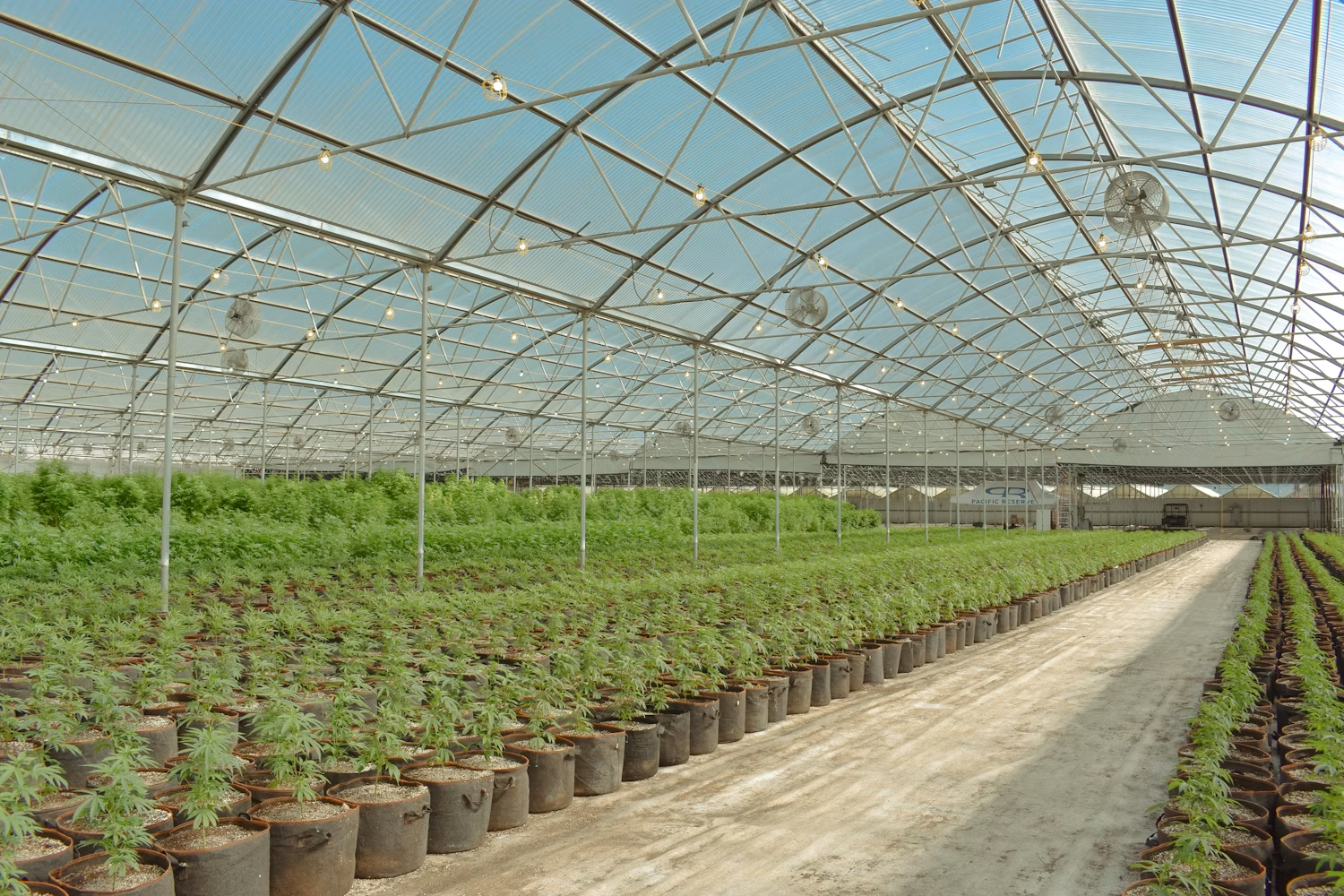
A cultivation license permits a business to grow cannabis plants for commercial sale within a specific state. It does not authorize manufacturing, retail sale, distribution, or transportation across state lines. Most states tier their cultivation licenses by canopy size — the total square footage of mature flowering plants — with Tier 1 licenses typically covering 5,000 square feet or less and Tier 5 or “Type 5” covering operations above 22,000 square feet.
Indoor, outdoor, and mixed-light (greenhouse) cultivation each require separate license classifications in most states. Tax obligations, security requirements, and reporting cadences vary significantly across these formats, so choosing the wrong classification on your application can trigger denial or require costly resubmission.
California — The Largest but Most Saturated Market
California issues cultivation licenses through the Department of Cannabis Control. Application fees start at $135 for Specialty Cottage Outdoor (up to 25 plants) and scale to $8,655 for Large Outdoor licenses. Annual license fees range from $1,205 to $77,905 based on tier and type.
To qualify, applicants must hold local authorization from the city or county where the cultivation site is located. This is the single most common bottleneck — only about 35% of California municipalities allow commercial cannabis cultivation. Once local approval is secured, state applications typically process within 90 to 180 days, though backlogs in 2025 pushed many applicants past 240 days.
Required documentation includes proof of legal right to occupy the cultivation premises, a detailed cultivation plan with water source disclosures, a security plan with 24/7 video surveillance specs, a fire safety plan, and disclosure of all owners holding 20% or more equity. California requires water rights documentation that trips up applicants who haven’t worked with a water attorney — improperly documented water sources account for roughly 18% of denials.
Colorado — Mature Market, Steady Issuance
Colorado’s Marijuana Enforcement Division issues cultivation licenses under three tiers based on plant count. Tier 1 covers up to 1,800 plants, Tier 2 up to 3,600, and Tier 3 up to 6,000. Application fees run $4,500 for new licenses, with annual renewals between $3,750 and $14,250.
Colorado requires applicants to demonstrate two years of state residency for at least 51% of the ownership group. This residency requirement has been challenged in court but remains enforced as of 2026. Applicants must also complete a financial disclosure showing source of funds for the entire build-out, not just the application fee. The MED rejects applications when source-of-funds documentation shows commingled personal and business accounts without clear paper trails.
Processing typically takes 60 to 120 days assuming complete submission. Colorado’s market is mature, meaning new operators face intense price pressure — wholesale flower has traded between $600 and $900 per pound through 2025, down from over $2,000 in 2020.
New York — High Opportunity, High Complexity
New York’s Office of Cannabis Management runs the most politically complex licensing process in the country. The state prioritizes Social Equity Applicants — individuals with prior cannabis convictions, family members of those affected by the war on drugs, service-disabled veterans, distressed farmers, and minority and women-owned businesses.
Cultivation licenses come in two main forms — Conditional Adult-Use Cultivator (CAUC) licenses, which are now closed to new applicants, and full Adult-Use Cultivator licenses with tiered canopy from 5,000 to 100,000 square feet outdoor or 25,000 indoor. Application fees range from $2,000 to $5,000 with biennial license fees from $4,500 to $200,000.
New York requires a Labor Peace Agreement with a bona fide labor organization before issuing any license. Skipping this step or signing with an unrecognized organization triggers automatic denial. Applicants also need detailed environmental and energy plans, including projected kilowatt-hour usage and carbon offset strategies for indoor operations above 25,000 square feet.
Expect 6 to 12 months from application to license issuance, with site inspections adding 30 to 60 days at the end.
Michigan — Open Market, Faster Turnaround
Michigan’s Cannabis Regulatory Agency runs an open licensing system with no statewide cap. Application fees are $6,000 for cultivation, with annual regulatory assessments ranging from $10,000 for Class A (100 plants) to $40,000 for Class C (1,500 plants). Excess Marihuana Grower licenses allow stacking multiple Class C licenses on one site.
Michigan requires municipal opt-in — local jurisdictions must affirmatively allow commercial cannabis, and roughly 1,400 of Michigan’s 1,773 municipalities have opted out. Securing land in an opted-in municipality, often in townships like Bay City, Lansing, or rural Upper Peninsula counties, is the strategic priority.
Processing runs 90 to 150 days. Michigan’s wholesale market collapsed through 2024 and 2025, with flower averaging $700 per pound, so new entrants need a cost structure tighter than legacy operators to survive.
Illinois — Limited Licenses, Litigation-Heavy
Illinois caps cultivation licenses tightly. The state issued 21 original cultivation centers and added Craft Grower licenses capped at 5,000 square feet (with scaling provisions to 14,000). Craft Grower application fees are $5,000 with annual fees of $40,000.
Illinois prioritized Social Equity Applicants in 2021 and 2022 lottery rounds, and those licenses faced years of litigation that delayed operations. New applicants in 2026 should expect lottery-based selection rather than merit-based scoring for any new license rounds. Successful applicants need a fully built-out facility within 180 days of license issuance — an aggressive timeline that has caused many lottery winners to forfeit licenses.
Common Reasons Cultivation License Applications Get Denied
Across all states, the same mistakes appear in denied applications. Incomplete ownership disclosure — failing to list passive investors, lenders with conversion rights, or option holders — accounts for the largest single denial category. Regulators treat undisclosed beneficial owners as fraud, not oversight.
Insufficient capital documentation comes next. States want to see proof of funds covering 12 to 18 months of operating expenses, not just startup costs. A bank statement showing $200,000 won’t impress regulators reviewing a $2.4 million build-out plan.
Site control issues kill applications regularly. A lease that doesn’t explicitly permit cannabis cultivation, or a purchase contract with cannabis-specific contingencies missing, will fail scrutiny. Landlords must sign acknowledgments that they understand the property will be used for cannabis activity.
Security plans that fail to meet state-specific camera, alarm, and access control standards are a frequent rejection cause. Each state has different minimum specifications — California requires 1080p minimum resolution and 90-day retention, while New York requires 4K with 60-day retention. Generic security plans copied across states routinely fail.
Background check failures stop applications cold. Most states permanently disqualify applicants with violent felonies, while non-violent and drug-related convictions are often allowed or treated as a Social Equity qualifier. Failing to disclose past convictions, even ones that wouldn’t have disqualified you, is itself disqualifying.
Realistic Timeline and Budget
For most states, plan on 9 to 18 months from initial decision to operational license. Budget breakdown for a Tier 2 indoor cultivation in a moderately competitive state typically looks like this — application and legal fees $75,000 to $150,000, real estate acquisition or lease deposits $200,000 to $500,000, build-out $1.5 million to $4 million for a 10,000 square foot facility, working capital $500,000 to $1 million, with total capital requirement landing between $2.5 million and $6 million before first harvest.
Pre-revenue runway of 12 months is the minimum buffer. Cultivators who launched undercapitalized in 2023 and 2024 made up the bulk of cannabis bankruptcies last year.
Next Steps
Before spending a dollar on legal work, confirm three things — your target municipality allows cannabis cultivation, you have site control or a path to it, and your capital stack covers 18 months of runway. With those three locked, engage a cannabis attorney licensed in your target state and begin the application work in parallel with facility design.
Browse vetted cannabis compliance attorneys and licensing consultants in the NextCanna Connect Compliance & Legal directory to connect with professionals who have shepherded applications through your target state.