Every cannabis plant grown commercially in a regulated state must be tracked from clone to consumer through state-mandated seed-to-sale software. Failure to maintain accurate tracking records is the fastest path to license suspension, with most states issuing fines starting at $5,000 per violation and stacking penalties for repeated reporting failures. Yet operators consistently underinvest in tracking infrastructure, treating it as a compliance checkbox rather than the operational backbone it actually is.
This guide compares the four most widely used seed-to-sale systems in 2026 — Metrc, BioTrack, Leaf Data Systems, and Flowhub — across pricing, state coverage, ease of use, integrations, and the operational realities of running each system day-to-day.
How Seed-to-Sale Tracking Actually Works
Each cannabis plant receives a unique RFID tag at the clone or seedling stage. That tag follows the plant through vegetative growth, flowering, harvest, drying, trimming, packaging, and final sale. At each stage, the operator records weight changes, waste, transfers between license holders, and final retail dispositions. States receive this data directly or via API integration with the tracking system, and discrepancies between reported weights and actual inventory trigger audits.
Two categories of software handle this — state-mandated tracking systems and commercial seed-to-sale platforms that integrate with state systems. Operators need both. State systems are the official record. Commercial platforms provide operational tools — cultivation planning, harvest scheduling, manufacturing batch records, POS integration — that state systems lack.
Metrc — The Dominant State System
Metrc is the state-contracted tracking system in California, Colorado, Michigan, Massachusetts, Maryland, Maine, Missouri, Montana, Nevada, Ohio, Oregon, Oklahoma, and several other states. Roughly 70% of US cannabis volume runs through Metrc. The system is mandatory in those states — operators cannot opt out.
Metrc pricing is set by state contract and typically runs $40 per month per license plus $0.45 per plant tag and $0.25 per package tag. A mid-sized cultivator with 3,000 plants will spend $1,500 to $2,500 monthly in tag costs alone.
The Metrc user interface is famously difficult. Built on aging architecture, the system requires manual data entry for most operations and lacks bulk editing tools that operators expect from modern software. Training new compliance staff takes 40 to 80 hours to reach proficiency. API access is available but rate-limited, which constrains commercial platform integration.
The strength of Metrc is its position as the source of truth for state regulators. When audits happen, Metrc records are what auditors review. Maintaining clean Metrc data is non-negotiable.
BioTrack — State System in Some States, Commercial in Others
BioTrack serves dual roles. In Washington, New York, Illinois, Hawaii, Delaware, North Dakota, and New Mexico, BioTrack is the state-mandated tracking system similar to Metrc’s role elsewhere. In other states, BioTrack operates as a commercial seed-to-sale platform that operators can choose to use.
As a state system, BioTrack pricing varies by jurisdiction but generally runs $200 to $400 monthly per license. As a commercial platform, BioTrack offers pricing from $250 to $1,000 per location based on transaction volume and modules selected.
BioTrack’s interface is more operationally usable than Metrc, with better bulk editing, batch management, and reporting tools. Cultivation planning, manufacturing recipe tracking, and lab result integration are stronger than Metrc’s native tools. Operators in BioTrack states generally report higher satisfaction than Metrc-state operators.
The weakness is integration. BioTrack does not integrate as broadly with third-party POS and ERP systems as Metrc does, since the commercial platform competes with those products.
Leaf Data Systems — The Quiet Player
Leaf Data Systems serves Washington (paired with BioTrack), Pennsylvania, and a handful of medical-only states. The system is reliable but limited in feature set, focused on compliance reporting rather than operational tooling. Operators in Leaf Data states almost always pair the state system with a commercial platform for actual cultivation and retail management.
Flowhub — Retail-First Commercial Platform
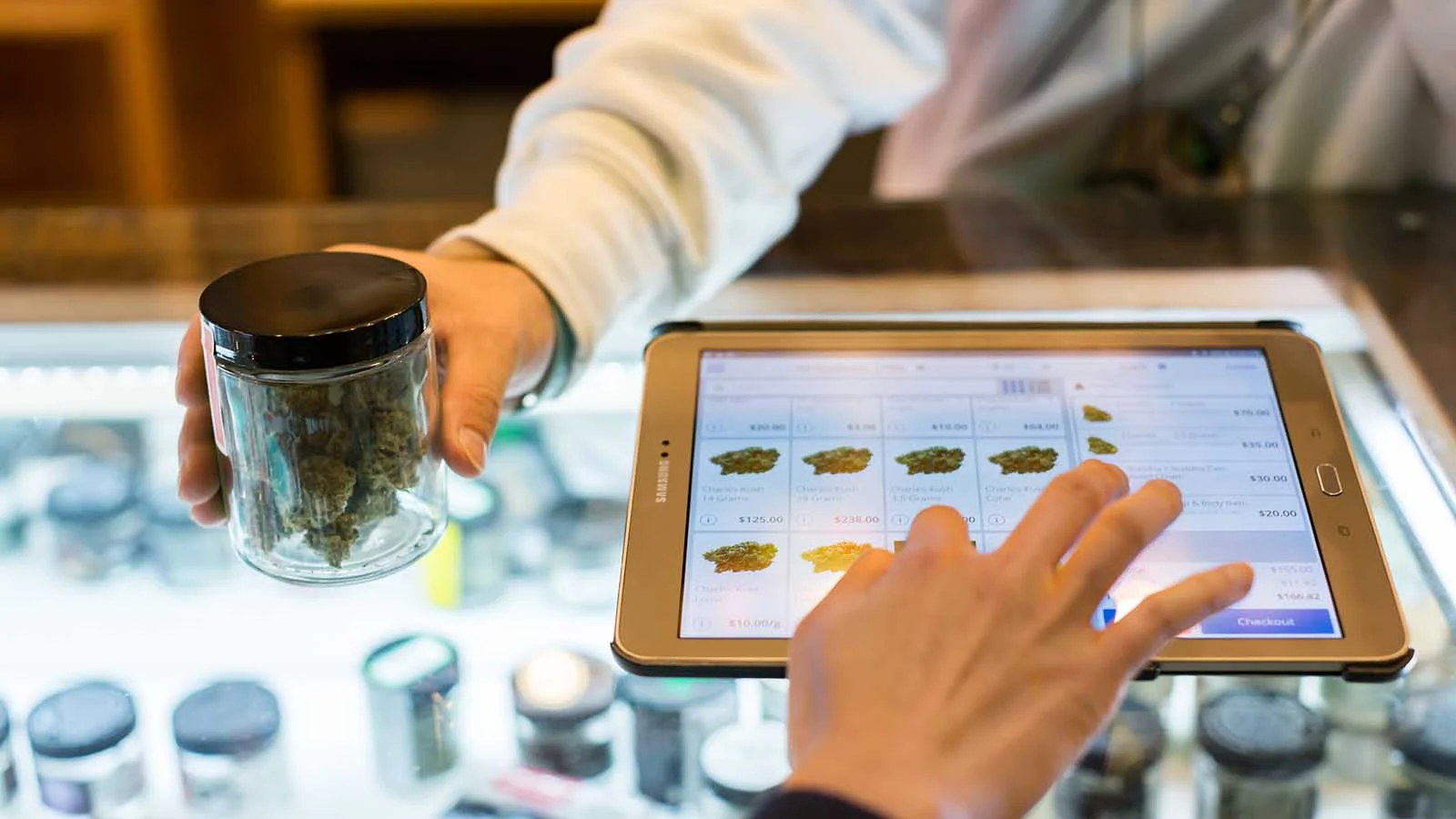
Flowhub is the leading commercial platform for cannabis retail. It integrates with Metrc, BioTrack, and Leaf Data, layering POS, inventory management, customer loyalty, and analytics on top of state tracking. Flowhub does not serve cultivation or manufacturing operations — it’s purpose-built for dispensaries.
Pricing starts at $499 per location per month for the base POS package and scales with add-on modules. Hardware bundles including iPad-based registers, receipt printers, and label printers run $2,500 to $5,000 per store.
Flowhub’s strengths are dispensary-specific workflows — age verification scanning, daily purchase limit enforcement, loyalty program integration with platforms like Springbig and Alpine IQ, and direct integration with online ordering platforms like Dutchie, Jane, and Weedmaps. Reporting on basket size, conversion, and budtender performance is best-in-class for cannabis retail.
The limitation is scope. Multi-vertical operators who cultivate, manufacture, and retail need additional software for the upstream operations.
Treez and Cova — Flowhub Alternatives
Treez competes with Flowhub in the retail POS category, with stronger enterprise features for large MSOs and better ecommerce integration. Pricing is similar at $500 to $1,500 per location monthly.
Cova serves smaller and mid-sized dispensaries with simpler pricing and faster onboarding. Cova works well for single-store operators who don’t need the deep customization Treez and Flowhub offer.
Integrations That Matter
The seed-to-sale software you choose must integrate with your other operational systems. Key integrations to verify before committing:
Accounting — QuickBooks Online or Sage Intacct integration is essential for daily sales reconciliation. Manual export to accounting is a major time sink.
Payment processing — Aeropay, Hypur, Paytender, and other cannabis payment processors need direct POS integration to avoid manual reconciliation.
Online ordering — Dutchie, Jane, Weedmaps, and Leafly all integrate with major POS systems, but integration depth varies. Confirm that online orders flow into POS as full transactions, not just menu syncs.
Loyalty — Springbig and Alpine IQ both integrate with major systems but require specific setup. Confirm before purchasing.
Lab results — Manufacturing operators need lab result import to integrate Certificate of Analysis data into product records.
What Goes Wrong
Inventory discrepancies between Metrc and POS are the single biggest operational headache. When a customer buys a product, the POS records the sale and Metrc records the package depletion. If those records diverge — due to manual edits, return processing errors, or sync failures — the audit-day reconciliation becomes painful. Operators should reconcile Metrc against POS daily, not weekly or monthly.
Manifest errors during transfers cause most cultivation-side compliance issues. Moving product between license holders requires accurate manifest creation in the state system. Wrong weights, wrong package IDs, or missing destination license numbers all trigger violations.
Tag application failures at the cultivation level — plants growing without proper tags, tags lost or destroyed without replacement — create cascading data integrity problems that are nearly impossible to fix after harvest. Strong SOP discipline at the cultivation level prevents these issues.
Recommendations by Operation Type
Single-store dispensary — Use the state-mandated system plus Flowhub or Cova. Budget $700 to $1,200 monthly for software combined.
Multi-state retail operator — Treez or Flowhub with centralized reporting tools. Budget scales with location count.
Cultivation-only operator — State system plus a cultivation management platform like Trym, Distru, or Canix for operational tooling. Budget $500 to $1,500 monthly per cultivation site.
Vertically integrated operator — Distru, Greenbits, or LeafLogix for end-to-end management. Budget $2,000 to $5,000 monthly per facility.
What to Ask Before Buying
Before committing to any commercial platform, demand a live demo using your actual workflows, not a generic walkthrough. Ask for references from operators in your state of similar size. Confirm contract terms — many platforms lock operators into 12 or 24 month minimums with stiff cancellation fees. Verify data export capabilities — you need to be able to extract your data in usable format if you switch platforms later.
Browse vetted cannabis technology and software providers in the NextCanna Connect Technology & Software directory to compare seed-to-sale and operational platforms with verified operator reviews.